


Nutrizoé
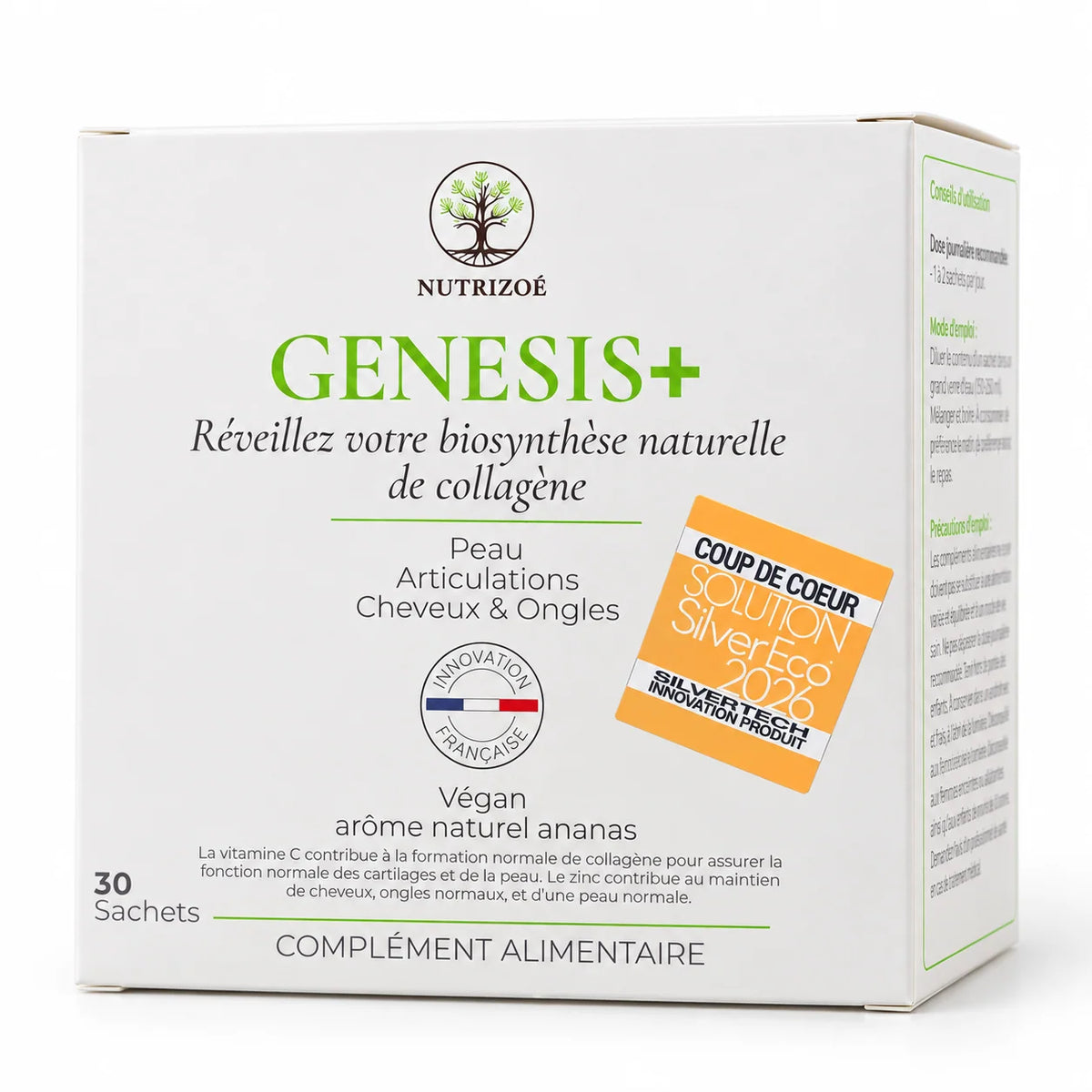
Awaken your natural collagen biosynthesis with GENESIS+
Awaken your natural collagen biosynthesis with GENESIS+
Verified customer reviews

SilverEco & Ageing Well Awards 2026
SilverTech Favourite, Product Innovation category
Awarded by the jury on 14 September 2026, at the Palais des Festivals in Cannes.
The GENESIS+ difference
Your body knows how to make its collagens. Help it.
GENESIS+ provides five amino acids that account for more than two thirds of the building blocks of collagens I, II and III**, combined with cofactors including vitamin C*. A 100% vegan formula, designed to accompany your natural collagen production.
- Building blocks & cofactors
- Vitamin C & zinc
- Five amino acids
- N-acetylglucosamine
*Vitamin C contributes to normal collagen formation.
**Triple-helix regions, by number of residues; hydroxylated proline and lysine included. Calculated on the human reference sequences. Source: UniProt.
Understand how your body makes its collagens (in French) →
La différence GENESIS+
Votre corps sait produire ses collagènes. Aidez-le.
GENESIS+ lui apporte cinq acides aminés à l'origine de plus des deux tiers des constituants des collagènes I, II et III**, associés à des cofacteurs, dont la vitamine C*. Une formule 100 % végane, pensée pour accompagner votre production naturelle de collagène.
- Constituants & cofacteurs
- Vitamine C & zinc
- Cinq acides aminés
- N-acétyl-glucosamine
*La vitamine C contribue à la formation normale de collagène.
**Régions en triple hélice, en nombre de résidus ; proline et lysine hydroxylées incluses. Calcul sur les séquences humaines de référence. Source : UniProt.
Comprendre comment votre corps fabrique ses collagènes →
3 produits
-5%
4+ produits
-10%
Choose your course
Couldn't load pickup availability
Batch no. 260324: best before 31/08/2028
 100%
Vegan Extra-soluble
powder Designed in France,
made in Italy


Your GENESIS+ reviews
The latest customer reviews, collected by Guaranteed Reviews.
Why does collagen production decline with age?
Collagen is the most abundant protein in the body: on its own, it accounts for around 30% of our proteins. It gives skin, cartilage, bones and supporting tissues their structure, suppleness and firmness.
The body makes it continuously, thanks to specialised cells: fibroblasts (skin), chondrocytes (cartilage), osteoblasts (bone) and tenocytes (tendons). These cells assemble amino acids (mainly glycine, proline and lysine) with the help of cofactors such as vitamin C. Its production therefore depends directly on the availability of these nutrients.
This is the key point: from the age of 25–30, the body itself makes fewer and fewer of these amino acids. Without enough building blocks, its cells produce collagen more slowly, and natural production declines year after year.

In short: with age, the body gradually loses its ability to produce the building blocks its cells use to make collagen.
How does the body make its collagen?

Making collagen is above all a job of assembly. Your cells link thousands of amino acids together into long chains, which then coil into a very strong triple helix: the collagen fibre.
Three amino acids keep recurring in this structure: glycine, proline and lysine. They are the main building blocks of collagen.
In fact, there is not just one collagen but several types, made by different cells depending on the tissue:
Fibroblasts
skin and ligaments
type I and III collagen
Chondrocytes
cartilage
type II collagen
Tenocytes
tendons
type I collagen
Osteoblasts
bones
type I collagen
Smooth muscle cells
blood vessels
type III collagen
For reference: type I accounts for around 90% of the body's collagen; type III accompanies it in the skin (around 20% of skin collagen) and in blood vessels; type II makes up most of the collagen in cartilage (over 80%).
Vitamin C plays a central role. It stabilises the chains by transforming proline and lysine (a step called hydroxylation), which is essential for strong fibres. This is why vitamin C contributes to normal collagen formation.
In short: collagen is not swallowed ready-made. It is assembled on site by your cells, from amino acids and with the help of vitamin C.
The GENESIS+ answer
Supporting your natural collagen biosynthesis
Biosynthesis simply means the making of collagen by your own cells. They continuously assemble amino acids, the way you would stack bricks. With age, it is not the walls that are lacking but the bricks: short of material, production slows down.
To understand what follows, keep one simple thing in mind: the body never uses a protein as it is. Whether it is an egg, a steak or collagen, everything is first broken down into amino acids during digestion. Animal collagen that you swallow therefore does not turn into human collagen: it is broken down, through energy-consuming digestion, into amino acids. And these amino acids are what matters: the basic building blocks, the bricks your cells then use, following their own blueprints, to make your own collagen.
Next, everything depends on the availability of the right bricks. Collagen is exceptionally rich in three amino acids, glycine, proline and lysine, far more than most proteins. If they run short, production slows down, even when everything else is present.
Two other amino acids complete this trio. Glutamine, itself a building block of collagens, is also a precursor of proline. Arginine is also present in collagens. Together, these five amino acids account for more than two thirds of the building blocks of collagens I, II and III**. This is exactly what GENESIS+ provides.
And bricks alone are not enough: you also need the right tool. To assemble and strengthen the fibres, your cells need vitamin C, which is why it contributes to normal collagen formation. Zinc, for its part, contributes to the maintenance of normal skin, hair and nails.
Now let us come back to animal collagen, marine or bovine. You swallow it already formed, but your body cannot use it as it is: like any protein, it must first digest it to break it back down into bricks. This route has two drawbacks. First, breaking down this collagen costs energy. Second, the resulting bricks arrive in the animal's proportions, calibrated for a fish or a cow, not for human biology.
This is precisely the detour that GENESIS+ removes. Since everything ends up as amino acids, it provides them directly, in the right profile and at the right doses, with vitamin C, which contributes to normal collagen formation, and zinc, which contributes to the maintenance of normal skin, hair and nails. No animal protein to digest, no detour.
Another route, 100% vegan: give your cells exactly what they need, and support the natural production of your collagen.
**Triple-helix regions, by number of residues; hydroxylated proline and lysine included. Calculated on the human reference sequences. Source: UniProt.
Animal collagen or GENESIS+: the real difference
In both cases, it is your cells that make the collagen. What changes is what they are given: animal collagen to digest, or the right amino acids directly.
Indirect route · animal collagen
Ready-formed collagen
↓ digestion to release the amino acids
↓ amino acids in the animal's proportions
↓ biosynthesis
Direct route · GENESIS+
Targeted amino acids + cofactors + NAG
↓ provided as they are, without digestion
↓ profile calibrated for human cells
↓ biosynthesis
| Indirect route (animal collagen) | Direct route (GENESIS+) |
|---|---|
| Ready-formed collagen (marine or bovine) | Targeted amino acids and cofactors |
| Must first be digested to release its amino acids | Amino acids provided as they are, without digesting a protein |
| Amino acid proportions inherited from the animal, not from your cells' needs | Profile and doses designed for the cells' needs |
| Animal origin | 100% vegan |
The key idea: whether marine or bovine, collagen must first be digested to release its amino acids. GENESIS+ provides them directly, in the right profile.
Designed to be taken every day, effortlessly
💧
Dissolves easily
Extra-soluble powder: one glass of water (250 ml) and it is ready, with no lumps.
📦
Individual sachets
An exact dose every time, easy to take anywhere.
🍍
Natural pineapple flavour
A natural pineapple flavour that makes every serving a pleasure to repeat each day.
In short: day after day, you give your cells what they need to build your supporting tissues.
How does GENESIS+ work?
To support this production, GENESIS+ brings together in a single formula what your cells use to make collagen: the main building blocks, their cofactors, and what is needed to maintain the matrix around them.
1. The building bricks of collagen
Glycine, proline and lysine, the most abundant amino acids in its structure.
2. Supporting amino acids
Glutamine and arginine: two amino acids also present in collagens. Glutamine is also a precursor of proline.
3. The cofactors
Vitamin C contributes to normal collagen formation; zinc contributes to the maintenance of normal skin, hair and nails.
4. The supporting matrix
N-acetylglucosamine, a component of the hyaluronic acid found around cells.
In short: GENESIS+ brings together the bricks, their cofactors and what is needed to maintain the matrix: everything your cells use to make collagen.
The science, in more depth
The collagen molecule is made up of thousands of amino acids, of which glycine, proline and lysine are the most abundant. The availability of these amino acids can limit the rate at which the body synthesises its collagen.
To assemble this collagen, certain enzymes (prolyl and lysyl hydroxylases) need vitamin C: this is why vitamin C contributes to normal collagen formation. Zinc contributes to the maintenance of normal skin, hair and nails.
N-acetylglucosamine is a component of hyaluronic acid, found in the extracellular matrix that surrounds cells.
References: de Paz-Lugo et al., Amino Acids (2018) · Barbul, The Journal of Nutrition (2008) · Kay et al., Molecular Metabolism (2022) · Pullar et al., Nutrients (2017) · Prasad, Molecular Medicine (2008). General biochemistry data, for information only.

Composition
Here is the full composition of GENESIS+, for two sachets per day.
| Nutrition information | RDD* (2 sachets) | RI** |
|---|---|---|
| Glycine | 10 g | |
| L-proline | 2 g | |
| L-glutamine | 2 g | |
| L-arginine | 1 g | |
| L-lysine | 1 g | |
| Vitamin C | 500 mg | 625% |
| Zinc | 15 mg | 150% |
| N-acetyl-D-glucosamine | 1 g | |
| Excipients | q.s. |
*RDD: Recommended Daily Dose · **RI: Reference Intakes
Ingredients: glycine, L-proline, L-glutamine, L-arginine, L-lysine, vitamin C, zinc, N-acetyl-D-glucosamine, natural pineapple flavouring, stevia-based sweetener, excipients.
Current flavour: pineapple. More flavours coming soon.
Batch no. 260324 · Best before: 31/08/2028. Store in a dry place, away from heat and light.
In short: doses designed to meet the real needs of cells, in a formula free from controversial excipients.
Who is GENESIS+ for?
GENESIS+ is for anyone who wants to support their body over the years. Thanks to vitamin C and zinc, its formula is linked to several recognised functions:
Joint comfort
Vitamin C contributes to normal collagen formation for the normal function of cartilage.
Skin
Vitamin C contributes to normal collagen formation for the normal function of skin.
Hair and nails
Zinc contributes to the maintenance of normal hair and nails.
Every day
A course designed to fit into your routine over time.
In short: a course that accompanies your skin, joints, hair and nails, day after day.
Frequently asked questions
Is GENESIS+ a collagen?
Why does it not contain marine or bovine collagen?
Should I combine it with a collagen?
Is GENESIS+ vegan?
What does it taste like?
How do I take GENESIS+?
How long does a course last?
Does the formula contain controversial excipients?
The story behind GENESIS+
GENESIS+ was born from a simple conviction: the body knows how to make its collagen, provided it has the right building blocks.
Rather than trying to replace what age reduces, we wanted to support this natural production: give the body the raw material, and let it do what it knows how to do.
From this idea came a French formula, 100% vegan, developed with our scientific team. A different approach to collagen, true to the way the body works.
The NutriZoé scientific team
Vitamin C contributes to normal collagen formation. Zinc contributes to the maintenance of normal skin, hair and nails. Food supplement; not a substitute for a varied and balanced diet and a healthy lifestyle. Do not exceed the recommended daily dose. Keep out of reach of young children.
All customer reviews

Free delivery from €65
At pickup points, in mainland France and Monaco

Secure payment
Bank card via Shopify Payments, or PayPal

